Показват се публикациите с етикет food. Показване на всички публикации

вторник, 19 юли 2016 г.

Lesson 2 - Shooting on a budget

If you love photography but you cannot afford to buy all the gear,  here is something that might help. I've tried most of the things so I will try to show in practice how some of the things work.
Image taken from http://addicted2success.com/success-advice/9-ways-you-can-make-money-online-with-photography/

I know you've been waiting for quite a while to get this but it's been a busy time. So I hope you like this one. 


Before we start - a disclaimer. 

If you are not prepared to invest in photography,  better find another hobby that speaks to you. It's not only money we're talking about - it's time, passion,  creativity. You can come up with amazing images using any gear,  it just takes some tweaking and more time to get the good results.


1. Keep your compact camera - cost 0€/£/$


What many people do after they buy their first DSLR is sell away the good old compact camera they have used before. My advice is - keep it!  Not only because it has served you well and doesn't deserve to be thrown away. You know how it functions and you know how to use it.
I will really try not to compare a compact camera and a DSLR but I can't help listing a few things. If you want to read the whole comparison - click here.

Even though the quality of compact camera shots cannot match the editing capacity of the ones produced by a DSLR, if you know what you're doing,  few would be able to tell the difference.  

Besides,  compact cameras (especially if they are equipped with good optical zoom) can be a good replacement for almost any lens you lack.  
One of my best images from Pisa - shot with a compact camera I still keep in my bag
A compact can give you the necessary zoom if you don't have a telephoto lens or it can give you the closeup you need to get that bee in shot without a macro lens. 
Compacts have one big advantage to DSLRs - well,  maybe except mirrorless cameras but judging by the amount of money they cost - no thanks - the size.  A compact is ideal if you need a video and don't have a tripod or if you need that amazing moment captured without drawing too much attention.

This wonderful view of some greenhouses was shot from a moving car - the compact enabled me to shoot handheld without needing that much firm and steady ground (because as you know roads are not always totally smooth) 
I managed to snap this street artist only because I used a compact and he didn't notice me.

Another shot from the compact - then toned on the computer
The best thing is that you don't need to pay a single coin for it - you already have it at your fingertips.  The only problem is that you'll need some time and patience to get the great results that would have taken you a few seconds with a dedicated lens.


2. Extenders and filters - cost around 200 €/£/$


You will need to pay a bit here - not much though. Extenders are those lovely things that make your kit lens a macro or (frankly I don't know what else but I'm sure that there are other options). 
As for filters - the biggest advantage is that they protect the lens from dust,  dirt,  water and - if you pay a bit more for a good quality one - from hits and falls.
One of my favourite images and actually a bestseller is shot with macro filters 
I almost always use this image as an illustration but it's just so good for this that I can't resist this time. Here the point is that it was really light around the waterfall - the ND 8 filter enabled me to use slow shutter speed - around 1/20 or less (can't remember right now) and so I achieved the blurry flowing water. Unfortunately, I didn't have a tripod so that's as slow as I could go.
A filter can transform the image and it's lightweight and cheap. You can,  of course add it in post-production but it's better to have it.


3. Colored and white paper ( and some colored clothing) - the ideal background for objects and food - cost around 50 €/£/$ (with some clothes included)


That one is shot on a blouse - I've never worn it, by the way, but it turned out to be perfect for object photography
Women are quite rich in clothes they have bought and never worn or worn only once and you can find white paper for printers in almost any house.  It may sound odd but these are perfect if you want to imitate a studio setting and you don't have the money to hire one or buy the expensive professional backgrounds.  
This one is taken on a wooden board 

Looks really nice, doesn't it - well, originally it is pijamas

Of course,  you'll need to tweak a corner or two on the computer but it would be worth it.  
Truth be told,  some of my best pictures are created with clothes for backdrop.


4. Use your house - cost 0€/£/$ 

You don't need a fancy studio to get amazing shots. Yes, you do some space but you already HAVE space - your home. No matter how big or small it is, you have a clean wall (or a big wardrobe), a window and a table. If you want to learn the basics of studio photography, that's all you need. After all, the hardest light to master is the sun. 

This one is made on a chair in the kitchen - all props coming directly from the kitchen - and using the only light available - the sun from the window


5. Ask friends for help - cost 0-10€/£/$ 

There's no need to do everything yourself. Tell others about your passion and they'll be more than willing to help. Props, space, advice about the best places to visit, even models - everyone can help with something. Most of them will do it even if you don't ask for help straight away. So don't be shy - it will be worth it. Besides, once you tell more people, you'll get more exposure. 

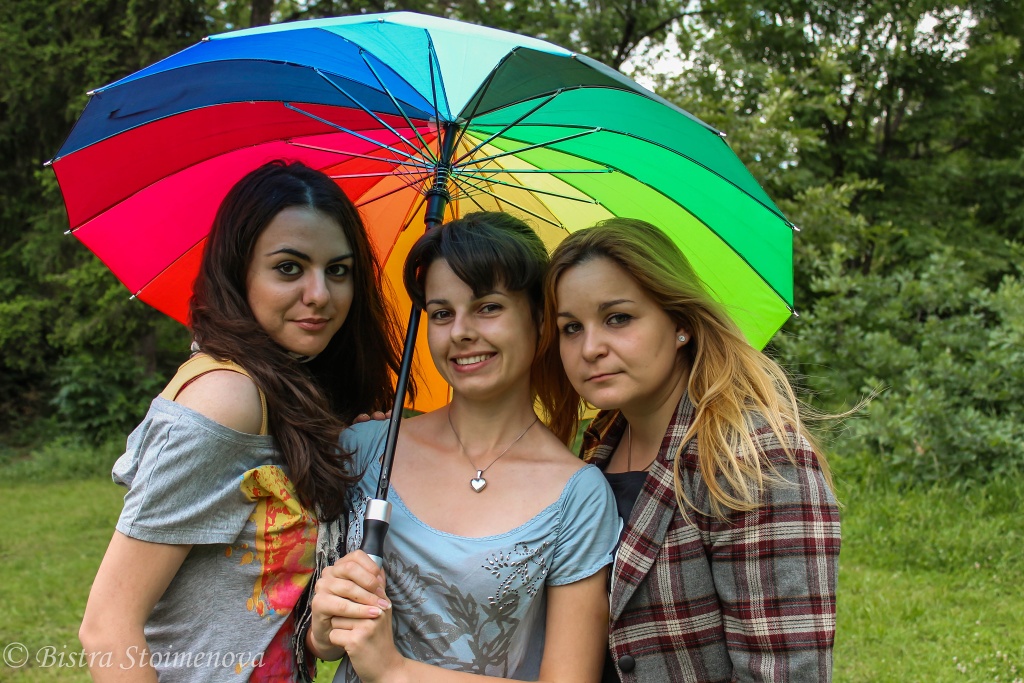
The girls on both images are colleagues of mine from the university - I asked them to make a photo shoot in the park and they were more than happy to come along. The umbrella belongs to one of them, by the way. So the only thing you need to do afterwards is to give the people some of the images - so that they help you out next time.

6. Borrow things - cost depends on how good a friend is the person and how you treat the thing. 

You want to try out that lens or you just need that reflector but you don't have them around? No problem if you know the right people - if you get into some Facebook groups you might find some people that are ahead of you and that are willing to help. You just have to ask - even if they turn you down, you would have tried.

If they give you the object, though, you'll have to treat it well and return it in the condition you got it.

These are not the only ways to improve your work without spending a lot of money. You know - when there's a passion, there's a way! 

неделя, 6 декември 2015 г.

Happy Saint Nicolas day! About the day and the saint. Part 1

Hi everyone, I haven't written in while but it had been a busy time for me. 
Anyway, the topic of the following post will have to do with religion, customs and above all - FOOD!

So let's get to religion first. Who is St. Nicolas and why do we celebrate the 6th of December each year? To tell you that I'll have to tell you a kindergarten story:

St. Nicolas was born in a wealthy family. His parents loved him very much and took good care of him but they died when he was a young man. St. Nicolas had no idea what to do with all the wealth left by his parents so he left it aside for a while. He didn't spend it, but he didn't give it all away either. One day, he heard a poor man complain to a friend - he had three daughters but could not afford to pay the dowry of even the eldest so that she could marry the man she loved. The poor man was worried of what would happen to his children if they don't get married - they will be avoided by the other members of the small society, insulted as burden to them, even deemed prostitutes - for why else would three beautiful young girls stay unmarried? St. Nicolas said nothing to the man - decided that first should check the story and learn more about him. So he followed him to see where he lived. It was a poor cottage and the man indeed had three beautiful daughters. While the girls were working, they were talking about the same things - how they won't be able to marry because on no dowry. St. Nicolas decided that if he gave the money in public the man would not accept them because of pride. So he devised another plan. The following night he slipped into the poor man's house and left three purses filled with gold coins by the side of each daughter's bed. The three girls rejoiced when they found the money the next morning. They got married soon after and lived in peace and joy with their husbands. Saint Nicolas found a good way to use the fortune left by his parents - whenever he saw someone in need, he just gave the money the person needed and left it by the side of the bed of that person at night. 

So, to cut the long story short - Saint Nicolas was the prototype of Santa Claus - the two names even sound familiar. he had been a real historical figure: here is how the wikipedia article puts it: 

Saint Nicholas (Greek: Ἅγιος ΝικόλαοςHagios Nikólaos, Latin: Sanctus Nicolaus); (15 March 270 – 6 December 343), also called Nikolaos of Myra, was a historic 4th-century Christian saint and Greek Bishop of Myra, in Asia Minor (modern-day Demre, Turkey). Because of the many miracles attributed to his intercession, he is also known as Nikolaos the Wonderworker (Νικόλαος ὁ ΘαυματουργόςNikolaos ho Thaumaturgos). He had a reputation for secret gift-giving, such as putting coins in the shoes of those who left them out for him, a practice celebrated on his feast day―St Nicholas Day (6 December, Gregorian calendar, in Western Christianity and 19 December, Julian calendar, in Eastern Christianity);and thus became the model for Santa Claus, whose modern name comes from the Dutch Sinterklaas, itself from a series of elisions and corruptions of the transliteration of "Saint Nikolaos". His reputation evolved among the faithful, as was common for early Christian saints. In 1087, part of the relics (about half of the bones) were furtively translated to Bari, in Apulia, Italy; for this reason, he is also known as Nikolaos of Bari. The remaining bones were taken to Venice in AD 1100.

The historical Saint Nicholas is commemorated and revered among Anglican,Catholic, Lutheran, and Orthodox Christians. In addition, some Baptist, Methodist, Presbyterian, and Reformed churches have been named in honor of Saint Nicholas. Saint Nicholas is the patron saint of sailors, merchants, archers, repentant thieves, children, brewers, pawnbrokers and students in various cities and countries around Europe.
Here is how St. Nicolas looked like - an icon - image taken from wikipedia.org
So, on the 6th of December we celebrate the day of St. Nicolas. Originally, it was the day on which children receive gifts. St. Nicolas was the original Father Christmas - before the 1920s and Coca Cola's marketing idea. 
In many countries children do receive gifts on that day, in Bulgaria there is a different tradition. Since he is the patron saint of sailors, on that day no one goes out at sea - it is said that from this day onwards - for a few weeks up to New Year's Eve - the sea is too dangerous to go into. The traditional dish is fish - nowadays of any kind but the traditional type is common carp - guess because the fish is very common in our region. Here is a picture of how it looks like - in case you don't know:
Image taken from: http://www.outdooralabama.com/common-carp 

So, the fish should be a whole one - not cut in pieces and when you buy it it should be with it's scales and all the organs inside it. The idea is that the scales bring in money and the whole fish symbolizes prosperity. Then, when you clean the scales, you bury them together with all the bones of the fish somewhere in the garden. Tradition says that you should fill the fish with rice - again the money connotation - and walnuts. Since you are supposed to be fasting before Christmas, St. Nicolas' day is one of the few occasions when you can eat fish - i.e. meat. Nowadays it is a wonderful time to get together with the family. 

I will post a picture of the carp we ate last year to get an impression of  what the whole thing looks like: 


As for this year's carp - I'll write again with the recipe and some pictures when it's ready. Wait for part two of the post :) 

сряда, 2 септември 2015 г.

Kiopoolu - or why many countries quarrel for the same dish


The Balkans are famous for many things - these days most of them are not nice at all - the financial crisis in Greece; the influx of refugees, corruption, low standards of living, high crime rate and so on and so forth. But, on the other hand, the Balkans have amazing landscapes, great food and hospitality (according to foreigners) to offer those who dare venture into that.


Point is, that very few people do so. And even if they do - the food is normally out of the question to taste. To us, the natives, there is nothing better for breakfast than a loaf of bread with sudzhuk (dried sausage that tastes way better than a salami), luitenitsa which is better than any ketchup you can come up with (or ajvar, or pinjur - or whatever the name in the country). 

It seems that, however, foreigners look at those the way an European would look at a table in the Sahara or with an exotic tribe somewhere in Oceania and there offered to eat roasted scorpions or dried slugs for breakfast. 
Some of the dishes do look weird or dangerous for your health, but trust me, any of those is 1000 times healthier than a hamburger. 
And here we come to the question - why is that so?
First we have to start with a little bit of history and geography. 
The Balkans = The Balkan Peninsula (in case someone doesn't know) are situated in the southeast of Europe - if you have the map - start from Spain and count the peninsulas - the Balkan is the third one from left to right. The name comes from the longest mountain range (Stara Planina in Bulgaria also known - for some reason - as Balkan)The climate is relatively warm and in most parts allows for four seasons to appear. That means that there is an abundance of spices, products and times of the year that give birth to some very strange results. 
The second factor, as I mentioned, is history. The Balkans are at the crossroads of Europe, Asia and the Middle East. Because of that many nations wanted to rule there or just traveled through and people came in contact with many different cultures, races and of, course - cuisines. 
So when the Ottoman Turks invaded and conquered the peninsula at the end of the 14th and the beginning of the 15th century, there was a lot there already. The conquerors, as all others before them, brought their cuisine with them. 
For most nations on the Balkans the existence within the boundaries of the Ottoman Empire lasted between 400 and 500 years. For that time, of course, the conquered had enough opportunities to get to know the new trends and they started adopting some Turkish words. 

So here we come to the problem - who invented kiopoolu? If you ask any of the Balkan nations, they will all proudly declare it was them. Judging by the name, however I am more inclined to think that it was the Turks that brought it to the Balkans. And it is not only that dish - nearly half of the cuisine on the Balkans is like that. I will keep that track in later posts. 

So, how do we prepare kiopoolu?

In case you want to taste that dish you'll need:

- baked and peeled RED and GREEN peppers (you can bake raw ones in the oven of you don't have them ready)
- baked and peeled eggplant (same as above)
- garlic (put as much as you can tolerate)
- parsley (same as above)
- black pepper
- salt
- olive oil (or whatever else you prefer)

So the first thing you have to do is to mash the peppers and the eggplants together - I prefer to have more peppers than eggplant but it is up to your preference. There are no strict rules - each one does it differently. DO NOT USE THE BLENDER - you'll get a ketchup - like substance that has NOTHING  to do with the original. The point is to get a paste in which you can see the ingredients. 
Then you add in the garlic, parsley and the spices and can eat that on a loaf of bread.

Enjoy!