сряда, 20 април 2016 г.
Featured in an application!!!
За вас притежатели на iPhone - вече можете да видите част от снимките ми в приложението Traveluv.
Labels:
adventure,
application,
bistra,
Bulgaria,
culture,
eastern,
exposure,
Greece,
history,
iPhone,
people,
photographer,
photography,
photos,
picture,
Romania,
site,
stoimenova,
Traveluv,
world
понеделник, 18 април 2016 г.
Belogradchik rocks - chasing the light - sneak peek
This is just a sneak peek of what I've been up to lately - hunting the perfect landscape shot. Belogradchik rock formations are one of the most spectacular places in Bulgaria - really, the view is amazing! Problem is that the light can be quite a false friend there. So in the following excerpt you'll read about my ordeals with the lighting there.
I promise to write a full-length travelogue and tell you all about it some time soon.About the place:
Belogradchik rocks in the late afternoon.It is a sandstone rock formation in the Northwest of Bulgaria. In Roman times, the rocks housed a garrison that used to guard the border and it had been so up till 19th century. Now the main part of the formation (from which I took the picture - I promise to post a shot of that soon) is still called Kaleto (the word for 'fortress in Turkish').
The rocks are to be included in UNESCO world heritage sites - there is a procedure under way.
Entrance:
You cannot stay inside after 6 pm - the fortress gets locked so there is no way to capture a sunset inside without getting a permit first. Same goes for sunrise. It's full of people - it's a very popular tourist destination, after all - so you don't have the time for a tripod or some tweaky long exposure tricks. Besides, the top of the formation is not that big so you don't have much space to move around either.This is my second visit to the place. You have no idea how difficult it is to get the right light there - even if you go at noon, the rocks would be black against the sky. So I went in the late afternoon and made sure it's a cloudy day. Still the result is not ideal so I guess I'll have to go a third time :) This time I'll make sure that the weather forecast says it's going to rain.
Entrance fee is 6 leva, last group goes in at 7pm (you can even listen to a tour guide but you have to pay some extra money - if you don't - as I did - been there too many times to listen to one and the same story all over again, besides - it was the pictures I was concentrated on - you can roam around freely and enjoy the view.). Outside the fortress you can buy some amazing local wine - totally recommend it!
Technicalities:
I used a wide angle lens (10 -18mm) and still had problems with filling the scenery into the frame. Besides, I could only see the images through the viefinder - the sun was shining in the LCD so I shot on autopilot - taking as many pictures as I could. Of course - since I knew that I'll need post processing - I used RAW format.Wishing you a wonderful week!
Labels:
Balkan,
Belogradchik,
bistra,
Bulgaria,
Carpathian mountains,
exposure,
heritage,
history,
landscape,
light,
photographer,
picture,
rock formation,
stoimenova,
UNESCO,
world
вторник, 12 април 2016 г.
Lesson 3 - the colour in things - White Balance
![]() |
| Image taken from http://stylopics.com/tag/tumblr-photography/ |
Welcome to lesson 3 where we are going to let the hardware be and go a bit into software instead. I know you had to wait fro quite a long time to read that and I hope that it's worth the wait.
By now you already know important is to set the correct aperture and shutter speed to get a good exposure in order to get a good shot. Here we are going to talk about another 'minor detail' that can ruin things if you are not careful. That's white balance.
By now you probably wonder what white balance is and why do we have to care about it. can whiteness can be balanced? Isn't white supposed to be only white? Yes and no. White balance stands for the way your camera sees the light regardless of what you see. It has to do with the computer inside the camera - remember that I mentioned that in the beginning? So that computer processes the shot BEFORE it gets recorded. Thus the light that to us may have no colour gets one in the picture.
So white balance matters - it's name comes from the way the white colour changes when you adjust the different settings. Most people learn that setting first. Some never get past that post. If you are wondering right now if you have used the feature or not - look below. if any of those icons looks familiar - you already have.
![]() |
| Image taken from http://www.geofflawrence.com/white_balance.html |
If you don't know where are they in the camera menu - take a look at the picture below:
When you click there you'll see this:
![]() |
| Image taken from http://blog.uniquephoto.com/quick-tip-how-to-set-custom-white-balance-on-a-canon-dslr/ |
So - here's the catch - the difference between those is measured in COLOUR TEMPERATURE - usually in degrees Kelvin - THE SMALLER THE NUMBER THE REDISH IT ALL LOOKS. Check out the table below to see what I mean:
![]() |
| Image taken from https://romangronkowski.wordpress.com/2014/10/22/white-balance-and-colour-temperature/ |
So we care about the colour temperature when we take pictures because if we do not select the right one - it will affect the way the whole picture looks like - and exposure will not correct things. Imagine it as an in-built Photoshop that works on your image before you can correct things. If you are not careful - you can get the whole thing wrong.
With some modes and some situations things are OK but sometimes you can get the whole picture looking red or blue or orange, Some photographers use it as a creative device (for example when you shoot a sunset you will want to get it as colourful as possible so you select a mode that would give you rich reds and oranges) but as a rule if you are a novice - TRY TO USE THE MOST NATURAL-LOOKING MODE. You'll need to switch between modes a bit but in time you'll know what to use when you see the object.
Do you feel knowledgeable already?
Labels:
aperture,
bistra,
camera,
exposure,
focus,
ISO senstivity,
lens,
lesson,
light,
lighting,
photographer,
photography,
photos,
picture,
pro,
shoot,
stoimenova,
study
петък, 1 април 2016 г.
Welcome spring!
Hello everyone!
Spring is officially here and I am excited - are you as well? I can't wait to start "hunting" down insects with the macro lens or indulge in landscaping somewhere in the country.
Spring is normally the time that brings us out of the lethargy of the cold winter and fills us with energy to change - ourselves, the garden, the decoration in the living room, the world...
I can't say that I will make some drastic changes in my work but I just hope that I will try to improve things - you know, you can't develop if you don't push your limits.
Meanwhile - here is a spoiler :)
Spring is normally the time that brings us out of the lethargy of the cold winter and fills us with energy to change - ourselves, the garden, the decoration in the living room, the world...
I can't say that I will make some drastic changes in my work but I just hope that I will try to improve things - you know, you can't develop if you don't push your limits.
Wish you a happy and fruitful spring, full of lots of new shots and other exciting adventures!
събота, 12 март 2016 г.
The photographic license - how the camera changes the behavior
I don't know if you have ever been in such a situation but it happens to me quite often when I get the 'big' 'professional' camera with me and head out shooting. Somehow when people notice you with that equipment, they seem to be more tolerant to what you do and even try to help. I called this 'the photographic license'
![]() |
| Image taken from http://www.picturecorrect.com/tips/what-are-stops-in-digital-camera-settings/ |
If you have studied literature, you probably know that there is such thing called 'the poetic license' that enables the poet to do whatever atrocities they like to the language - use nonce-words, revert word order etc. I discovered that the same (or almost the same) goes for photography.
As if there is something magical in the equipment and for some reason it makes people take you seriously.
I had this case when I wanted to go shooting at the German Weihnachtsmarkt at the center of town. So far so good, but at the moment I had only my old and favourite compact red Canon PowerShot with me. I went no matter what because I felt that I have to - it is a gut feeling. Guess what - I was snapping away but people did everything to make my life hard - got in my way, bumped into me, intruded in the shots or - didn't notice that I exist.
I managed to get some amazing shots that evening - no matter what. The picture below is one of my favourite Christmas pictures ever and maybe one of the best Christmas moments I have ever captured. Unfortunately I never got to know the woman or the child - they went away without even noticing me.
The next evening I came back with the 'real' gear - black 'professional' camera and all. Guess what happened? Everyone stepped out of my way, practically no one bumped into me and when people saw me - they backed out of the way and even tried to help me arrange the thing I wanted captured.
I've seen that at travel locations as well - people tend to pay more attention to you when you carry a big, Terminator-like black 'professional' camera than if you carry a compact one - even though you are one and the same person anyway. I will keep writing professional in inverted commas because I think that the professional is the person behind the camera and the equipment alone cannot make you a pro. That is a topic of another post, however.
That had me thinking - why does it happen? Why people behave that way? Is it me or is it the gear?
That led to another question- does my behavior differ when I get the big camera on?
The answer came one evening on location (Sighisoara, Romania, by the way - promise to tell it all in a travelogue) and was confirmed when I had to shoot at one or two events. I am generally not a shy person (well, not an introvert, at least) so that came as a shock to me at first. I noticed that the moment I hide behind the lens I become bolder and am willing to do things I would probably never do without the camera in front of me - like asking a complete stranger at a fair to pose for the camera and if you can photography their goods, to walk around a town in the late afternoon when there is no one around and it actually gets scary because the area is so remote and you are a foreign girl 165 centimeters tall. That camera makes me go and hang over a 80-meter bridge or climbing a rickety coast guard viewpoint or go into the bushes and the sand (despite the chance of finding a snake or a scorpion) for the one and only purpose of getting the right shot.
But there came another question - I did the same when I had a smaller camera. Why didn't people take me seriously then? The answer, I guess, lies in the gear. The bigger and scary/professional -looking it is, the more people start thinking 'Hey, look at her - she MUST be a pro, let's get out of the way!' or if they don't like getting photographed 'Oh, is that a photographer over there? She must be - look at her camera and stuff... I must get out of here before she takes a picture of me!'
So, in a way, people do license you with their behavior and you are free to act as you like. I normally use the moment to get better access to the location - if that is possible - or to get a photo of someone or something I like. When I have a camera in hand I am prepared to do almost any kind of idiocy to get the right shot. (and believe me - I have a few idiotic stories to tell come to think of it). With a camera in hand, there are no language barriers.
So, what do you think?
Is there a photographic license and does holding a camera change you or the people around you?
I had this case when I wanted to go shooting at the German Weihnachtsmarkt at the center of town. So far so good, but at the moment I had only my old and favourite compact red Canon PowerShot with me. I went no matter what because I felt that I have to - it is a gut feeling. Guess what - I was snapping away but people did everything to make my life hard - got in my way, bumped into me, intruded in the shots or - didn't notice that I exist.
I managed to get some amazing shots that evening - no matter what. The picture below is one of my favourite Christmas pictures ever and maybe one of the best Christmas moments I have ever captured. Unfortunately I never got to know the woman or the child - they went away without even noticing me.
The next evening I came back with the 'real' gear - black 'professional' camera and all. Guess what happened? Everyone stepped out of my way, practically no one bumped into me and when people saw me - they backed out of the way and even tried to help me arrange the thing I wanted captured.
I've seen that at travel locations as well - people tend to pay more attention to you when you carry a big, Terminator-like black 'professional' camera than if you carry a compact one - even though you are one and the same person anyway. I will keep writing professional in inverted commas because I think that the professional is the person behind the camera and the equipment alone cannot make you a pro. That is a topic of another post, however.
That had me thinking - why does it happen? Why people behave that way? Is it me or is it the gear?
That led to another question- does my behavior differ when I get the big camera on?
The answer came one evening on location (Sighisoara, Romania, by the way - promise to tell it all in a travelogue) and was confirmed when I had to shoot at one or two events. I am generally not a shy person (well, not an introvert, at least) so that came as a shock to me at first. I noticed that the moment I hide behind the lens I become bolder and am willing to do things I would probably never do without the camera in front of me - like asking a complete stranger at a fair to pose for the camera and if you can photography their goods, to walk around a town in the late afternoon when there is no one around and it actually gets scary because the area is so remote and you are a foreign girl 165 centimeters tall. That camera makes me go and hang over a 80-meter bridge or climbing a rickety coast guard viewpoint or go into the bushes and the sand (despite the chance of finding a snake or a scorpion) for the one and only purpose of getting the right shot.
![]() |
| The viewpoint I was talking about. From that angle you can see that it is not exactly vertical... |
![]() |
| An accidental shot I took while almost falling off the viewpoint. Turned out that it is not used for a reason. Saw that picture wile flipping through the photos at home. |
So, in a way, people do license you with their behavior and you are free to act as you like. I normally use the moment to get better access to the location - if that is possible - or to get a photo of someone or something I like. When I have a camera in hand I am prepared to do almost any kind of idiocy to get the right shot. (and believe me - I have a few idiotic stories to tell come to think of it). With a camera in hand, there are no language barriers.
So, what do you think?
Is there a photographic license and does holding a camera change you or the people around you?
сряда, 24 февруари 2016 г.
Lesson 1 - Compact camera Vs DSLR. Do I need a DSLR to get good pictures?
![]() |
| Image taken from http://www.theguytravel.com/tips-to-getting-the-ideal-travel-photography-shot/ |
Hello everyone, welcome to lesson 1 of the Shoot Like a Pro - Advanced!
When we talk about the pro side of photography, the first question you need to ask yourself is - Do I need a DSLR.
Most photographers would even laugh at that very statement. To them it is self-evident that the DSLR is 100 times better than a compact. That may be true but the point here is to show the differences between the two.
In this post I will try to help you make an informed choice and know the limitations of each kind, at least, and then try to explain to you that what matters is the 'gear behind the viewfinder', not so much the gear itself. But before we get to that part, let's compare a compact camera to a DSLR to see what we can choose from.
Compact camera - pros
- lightweight
- all-in-one function lens
- cheap
- user-friendly (most of the time)
- doesn't attract unwanted attention.
OK, what 99% of all photographers (here I include the selfy-lovers, the casual snappers and well, everyone who has ever taken a picture, not only photographers whit a capital P) have or have had at some point in their lives is the compact camera. It has a few advantages, especially if you are a beginner.
You don't need to rob a bank to buy one - advantage number 1. It's normally equipped with all the settings you may need for some time - like macro setting, some telephoto options (the optical zoom, I mean) and even (if you choose carefully) manual/ shutter speed and aperture priority modes. It has a built - in flash and the whole thing rarely weights more than 500 g. Another plus is that you can get by unnoticed as the occasional snapper at tourist destinations and thus - doesn't attract unwanted attention.
Compact camera - cons
- You cannot attach any accessories to it
- bad quality optics (most compact models) with limited abilities
- SMALL (I mean, really small) sensor
- 99% of the models don't have manual focus
- Bad performance at high ISO settings
- Impossible to use in low light/ night mode - cannot work with shutter speed slower than 15 sec.
- Not weatherproof - get it wet and you will regret it (A LOT!!!)
- Slow focus in any mode
- Shoots in JPEG format only
Here we come to the bad news part. First of all - at least to me - a compact camera is NOT waterproof. I mean, not even close! Get it wet and you will regret it! I did so once - in a torrential rain in Venice - and then the inner lenses (not the one that you can clean) got wet and I could use it for the following hour before it dried up. Luckily, the rain stopped by that time, too. If you get a compact soaked, better throw it away. I was lucky that mine was not soaked, it seems,
![]() |
| Amazing pic, right? Problem is that it is taken at ISO 3200 with a compact camera - so it is suitable only for prints up to size A4 . Taken on that fateful day in Venice. |
Compact cameras have slow focus (no matter what the specs say) because the only way to work is to project the image on the screen (because they are mirror-less cameras and don't have a viewfinder), so when they focus it takes additional second to project it all at the back of the camera on the LCD monitor. The other reason for the slow focus is the auto focus - which is alway ON. Auto focus is the only available option for 99% of the cameras. Those with touch screen have a function that can override it and get things better - the touch focus (when you tap a place on the screen and it is the spot where the camera focuses). Even if the specs say that there is a manual focus option - better go without it - probably it would be so slow and user-unfriendly that you would regret staring in the first place.
![]() |
| One of my favourite macro pictures - but it has problems in focusing - due to the autofocus. As you can see - the background is quite in focus - not as blurry as we would like it to be. |
Lack of manual focus slows you quite a lot, especially if you are doing quirky things like macro, wildlife, portraits. The camera would focus where it CAN, which sometimes grossly differs from where you want it to focus.
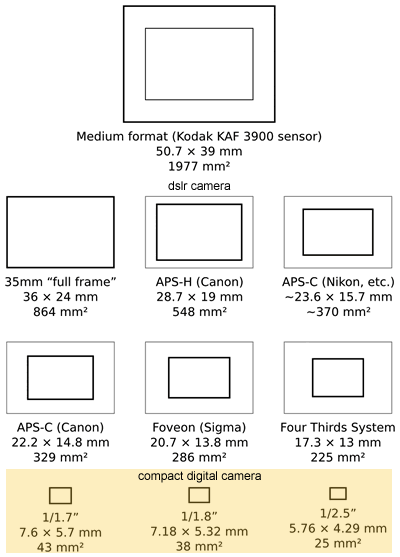
Next in line is the sensor. Having a compact camera means that you will have a very small sensor. The sensor in the camera is the part that determines the image quality (it does NOT depend on the megapixels, no matter what 99% of the people think.) You can buy a 20 megapixel compact camera but it would still have a small sensor. Having a small sensor means that you'd be able to capture less of the breathtaking scenery with one shot and your images would be of poorer quality compared to the same shot taken with a DSLR. In most cases, you cannot tell the difference if the conditions are good - lighting is OK, weather is fine etc. Problem is that they are seldom so and the best pictures are taken in bad conditions. Small sensor means that your images would be practically useless after ISO 800 (trust me, I know) or in bad weather - dusk and dawn included.
The optics of a compact is rarely top quality (again, no matter what the specs say) - which you may get a good shot but it can't be comparable to a special lens on a DSLR (of course, that are minor differences that cannot be noticed at first sight). It all depends on what you are shooting. Most compacts are practically incapable of getting a bokeh (the blurry out-of-focus background that we love so much in portraits) because the millimeters of the lens start at somewhere between 5 and 10 (which is wide angle aka pin sharp). So whatever you shoot with the lens of a compact - you cannot get is as blurry as you would like to because the lens just cannot do it (promise to explain that in another post.)
Compacts cannot use accessories - like external flash, remote trigger or filters - and cannot be used with shutter speed slower than 15 sec - so say goodbye to night shooting and sunsets or to blurry seawater and clouds.
DSLR- pros
- Full range of lenses to get all possible things captured
- Full range of accessories
- Full manual mode and control of what you do
- Bigger sensor
- Performs well with ISO up to 6400 (the bigger the camera, the higher the decent quality at high ISO goes)
- Manual focus!!! (ALL lenses have it) + image stabilizer (some lenses have it)
- Weather proof - to some extent
- Can be used in low light but needs a tripod
- Quick focus (most of the time)
- Has a viewfinder so you don't need to watch the LCD all the time.
- Shoots in JPEG and RAW
DSLRs generally have better optics because they are many - many, many. You can buy a full range of them to get what suits your purpose. You can also buy all kinds of accessories to enlarge your kit - filters, tripod(s), flash(es) etc. With a DSLR you have full control over what you do - as my mother says about complicated gear - it would do the washing and then hang the clothes to dry if you let it.
Most DSLR models do well with ISO as high as 6400. Focus is quick (especially if you use the viewfinder) and you can generally use it in any conditions (as long as it is not extreme weather - blizzard, sandstorm, torrential rain etc. ).
The sensor of s DSLR is bigger, so you can get more of the scenery in one shot. Bigger sensor also means better performance in bad conditions such as low light, dusk and dawn and above all - better image quality. You can shoot in RAW (which is the general photo format for post production) as well as JPEG.
![]() |
| A graph that shows the difference in the sensor size Image taken from http://www.fabiovisentin.com/blog/38.ashx |
DSLR - cons
- Expensive - VERY
- Accessories are even more expensive than the initial purchase
- No all-purpose lens - you either need to carry 2 or 3 with you or to get satisfied with limited angle
- HEAVY (a lot)
- You get noticed immediately - which can attract unwanted attention
- User-unfriendly and cumbersome if you are a beginner
- You need a lot of knowledge to get a decent shot in full manual
There is no all-purpose lens - the macro lens cannot do landscapes (because it has a limited angle of view and for landscapes you normally want to put in the frame as much as possible) and the landscape lens cannot do macro or wildlife (because it cannot focus close enough to the object) the portrait lens is good but if you try to do landscape with it - it won't be sharp enough... If you are goingon a trip, you would probably need to carry more than one lens with you (which adds to the weight again).
When using a DSLR, you immediately get noticed in the crowd. I mean INSTANTLY. That singles you out as a possible victim of pickpockets and attracts unwanted attention from officials and a=can get you in trouble if you get caught taking pictures of something you shouldn't be.
![]() |
| Taken from http://wasabinoise.com/index.php?showimage=45 |
If you are a beginner, you'll need quite a lot of knowledge to handle it properly - so at first it could be quite user-unfriendly and slow to handle.
Here comes the question - Do I need a DSLR to get good photos or can I continue using my old camera?
To answer that question, please answer the following questions HONESTLY.
- Do you know your current camera inside out?
- Have you used all the settings of your current camera?
- Can you produce good images with your current gear?
![]() |
| Same place as the one with the mountain above, just taken a few hours later. again with the same compact camera. |
- Can you afford a new camera and are you willing to keep investing in it?
- Why do you want to change your gear?
If you want a camera like that just because all your friends have - ask yourself - do you really need it or is it just a whim.
- Are you willing to cope with the weight every time you go somewhere?
That may not be a problem if you are a man, but for women it is. Even if you are fortunate to be strong enough to handle all the weight - do you really need all that all the time?
Counter to what I said above - what creates the good shot is 50% chance and conditions, 30% talent/skill and inspiration and 20% gear. A good photographer can handle well and produce good and even fantastic photos with whatever is available. Any equipment would do - trust me, the best equipment is the one that you have in your bag right now.
A few years ago - when I was only dreaming to get a DSLR (an to be honest, it was only in a joke-like manner) I met a man carrying a DSLR around. He and his wife were staying at the same hotel as we did. So one evening, after we had been at the same location at roughly the same time, I asked to see the pictures (hoping that they would be better than mine). Imagine my horror when he just shrugged and just told me he had taken a few shots ... in AUTO mode. Why. on Earth, do you need a DSLR if you use AUTO??? You can use any camera for that purpose.
Counter to what I said above - what creates the good shot is 50% chance and conditions, 30% talent/skill and inspiration and 20% gear. A good photographer can handle well and produce good and even fantastic photos with whatever is available. Any equipment would do - trust me, the best equipment is the one that you have in your bag right now.
![]() |
| That one is taken with a 3-megapixel cameraphone. |
![]() |
| This one is taken with a smartphone. |
In conclusion I want to add gear always helps but it doesn't create masterpieces. You do.
Labels:
bistra,
camera,
compact,
DSLR,
exposure,
ISO senstivity,
lesson,
light,
like,
photographer,
photography,
photos,
picture,
pro,
shoot,
stoimenova
неделя, 21 февруари 2016 г.
Corinth Canal - part 2 - or why getting lost helps?
I've always wanted to take a picture of Corinth Canal with a boat inside it - you know, like the iconic picture below.
![]() |
| Image taken from http://traveltamed.com/places-to-visit-in-greece/ |
If you have read the previous post, you already know what happened on day 1 and you probably know that I was dead-set on getting things right today. This part of the story starts in the morning at the hotel reception.
Totally into the idea of getting a shot like the one above, I went to ask about ships. After all, they should know, right? The guy at the reception was very helpful but I doubt he understood much of what I had in mind told me that tourist boats go inside the canal but big ships are few and far between. Still, I was determined to go there and take my iconic shots.
In the morning we went to Mycenae (which is the topic of another post) and at 11 am we drove back to Corinth - the distance is roughly 60 km.
Where IS the canal???
There was a road sign on the highway but from Peloponnese there was none. So we got a panoramic view of Corinth and its streets. And the oil refinery. If you book a hotel - check where it is on the map because there is a very high chance of being close to the refinery. And that is HUGE! If the hotel is close - you will enjoy the smell of petrol derivatives 24/7. Corinth is a really nice town with plenty of things to see for it's size and no doubt - amazing accommodation and taverns - but the smell of petrol is not one of my favourites. Luckily we checked that BEFORE we went there.
We went in and out of Corinth several times during some of which we came close to the channel. Twice we went over a submersible bridge at one end of the canal and we kept driving along one of its sides.
You can see it's there but you cannot reach it. You see where it is but you don't see where to turn for the viewpoint.
Time went on and the sun went down - and I got nervous. Meanwhile we kept circling the streets of Corinth.
After all, we had only two days in that part of Peloponnese and it was already day 2! Bearing in mind that the pictures from yesterday I can happily delete at any instant because they show nothing of the canal that I wanted to capture. (you can see the previous post to get the impression of how bad things were).
After a few zig-zags in and out of Corinth - AGAIN! - we got to the viewpoint. Time: 12.30. Not too late, I hoped. I got out of the car and started running - at 30 degrees plus Celsius - and started frantically taking pictures of practically everything I got my lens on. Thank God I got the wide angle lens!!!
Time went on and I got to the other side of the bridge (remember what I told you about the viewing platform being nonfunctional).
By the time I was done with preliminary shots, it was around 1 pm.
Guess what??? At the far end of the canal I saw a boat approaching! A BOAT! No matter the time, I was totally into waiting for the boat to come to me - and even to get out of the canal.
It was the picture-postcard thing I wanted to do!!! So I waited - it turned out that I didn't have to wait for a long time - some 15 minutes.
It was a miracle! My dream came true (well - sort of - it was a big ship but this little boat was ideal to show ho big th channel is).
So I started snapping as if I had a machine gun - click, click, click, chat, chat, chat, chat! I LOVED IT!!! I was glad we got lost, after all - because otherwise we would have gotten to the canal earlier and we wouldn't have seen the boat.
Sometimes getting lost helps.
Now, the technical information: how to get a picture like that?
There are several tourist boats that get inside the canal - either to show it to the tourists or just for the fun of being photographed from above (the people in the boat were having a great time while I was taking those shots). The boats have different schedule - so make sure you check it out first before you get on location. I think that there is at least one of them that gets inside the channel at midday - which means - somewhere between 12.00 and 13.00 pm and I think that there is another one later on during the day.
![]() |
| One of the beaches of Corinth that I managed to shoot along the way. |
![]() |
| The bridge I was talking about |
![]() |
| The lagoon - the black and yellow thing on the left is the bridge |
![]() |
| The end of the canal as seen from the submersible bridge. The image is taken from a car in motion - you cannot stop there |
![]() |
| One of the views of Corinth I managed to capture |
![]() |
| The view from the submersible bridge - again! |
![]() |
| The canal from the other side of the bridge |
By the time I was done with preliminary shots, it was around 1 pm.
Guess what??? At the far end of the canal I saw a boat approaching! A BOAT! No matter the time, I was totally into waiting for the boat to come to me - and even to get out of the canal.
![]() |
| One of my favourite shots from the day and roughly what I came to Corinth for :) |
It was a miracle! My dream came true (well - sort of - it was a big ship but this little boat was ideal to show ho big th channel is).
![]() |
| Another of my favourite shots |
Sometimes getting lost helps.
Now, the technical information: how to get a picture like that?
The boats
There are several tourist boats that get inside the canal - either to show it to the tourists or just for the fun of being photographed from above (the people in the boat were having a great time while I was taking those shots). The boats have different schedule - so make sure you check it out first before you get on location. I think that there is at least one of them that gets inside the channel at midday - which means - somewhere between 12.00 and 13.00 pm and I think that there is another one later on during the day.
The light
Make sure to be on location at midday - when the sun falls directly from above and the water inside the channel looks azure. Trust me, you won't regret it.
If it is cloudy - any time would be suitable. But the water is less likely to be azure.
Clothing
It is generally HOT in Peloponnese 7 months out of 12 and temperatures rise up to 30 degrees Celsius (and often higher - when we were there temperatures ranged from 30 to 38 in different parts of Peloponnese) so make sure you have sunscreen, a hat (it's windy at the bridge so make sure you keep it ON your head in some way) shorts and a T-shirt. Sneakers are a must - you'll need all the stability you can get while on the bridge.
![]() |
| The bridge - again, in case you didn't pay attention last time |
Gear
Any camera would do but let's try to get the DSLR settings:
- manual mode - f/8 - f/18 (depends on your ideas and the amount of light) - you need a BIG f/ number to get the bottom of the channel sharp; shutter speed - 1/320 sec + (in case there is a boat around - they move quite fast)
- images shot in RAW (or the highest quality JPEG) - so you can use your files later on.
- lens - wide angle is a must - you don't have much space to move around either way. 10-18 mm is a good choice but if you don't have one - use the widest setting of your lens (normally that is 18 mm). Forget about telephoto lenses unless you want to get a portrait of someone in the boat below.
Safety precautions
Corinth canal is one of the two entry points from mainland Greece to Peloponnese (I keep repeating that, I know, but I hope that it gets stuck in your head) - the road that hosts the railing is VERY VERY BUSY!!! You can see trucks, buses (tourist and municipal) and cars of all brands and sizes driving over it at any minute. So:
Last note - Corinth Canal is one of the most spectacular places I have been to. If you are in the area - do go there. It's worth it!
Corinth has other places to see as well - Ancient Corinth is a must - see and has a great view and they have to have a museum or two.
For those in love - bring a padlock and lock it on the bridge - many couples do that like they do it in France. As you can see from the picture above - they are quite a few.
- Do NOT go in the middle of the road for no reason (it is narrow enough)
![]() |
| The railing of the bridge in detail. |
- Do NOT hang over the railings!!! You don't want to risk a 70-meter fall down to the 8-meter deep water. (I am myself afraid of heights and that one took my breath away but still...) If the other viewing platform is still closed (as it was when I was there) DO NOT TRY TO GET ON IT!!! If they closed it - they probably did it for a reason - probably it is not stable enough to host ANYONE. DO NOT play the hero!
![]() |
| A side shot of the canal to show you ho deep it is. |
Corinth has other places to see as well - Ancient Corinth is a must - see and has a great view and they have to have a museum or two.
For those in love - bring a padlock and lock it on the bridge - many couples do that like they do it in France. As you can see from the picture above - they are quite a few.
Labels:
adventure,
bistra,
bridge,
canal,
channel,
Corinth,
Greece,
isthmus,
lens,
lighting,
Peloponnese,
photographer,
photos,
pictures,
stoimenova,
study,
travel,
vacation,
view
Абонамент за:
Публикации (Atom)